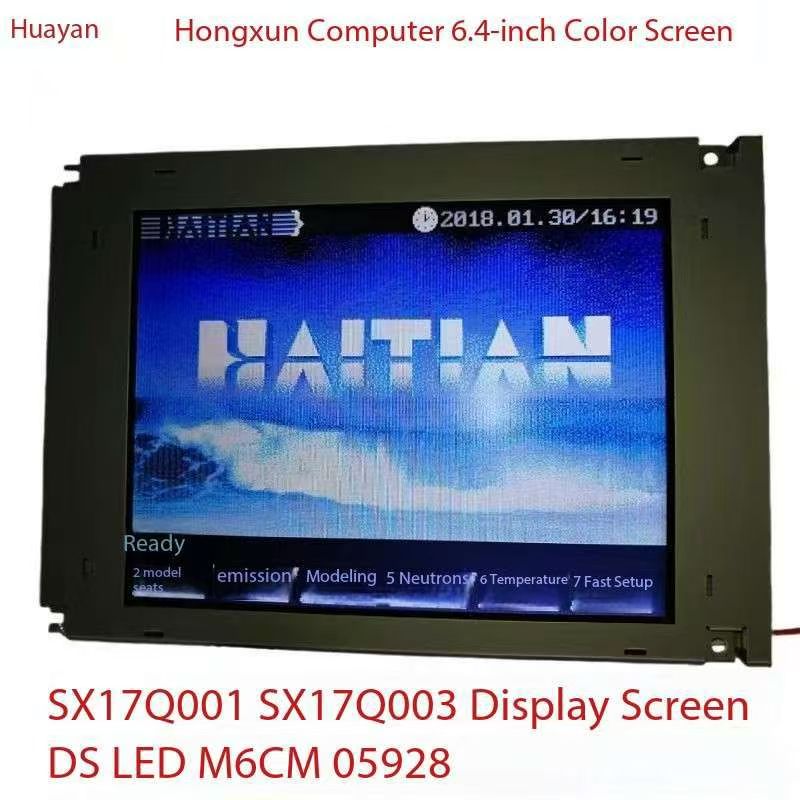
Injection Molding Machine Parts Display Screen":
------
I. Core Functions of the Display Screen
1. Real-Time Operation Monitoring
• Displays live data for mold opening/closing, injection, packing, and material feeding processes (e.g., pressure, speed, time).
• Monitors critical parameters such as hydraulic oil temperature, barrel temperature, and mold temperature to ensure process stability.
• Shows cumulative operating hours, mold opening cycles, and other statistics to support maintenance planning.
2. Parameter Setting & Adjustment
• Enables configuration of injection pressure, speed, time, temperature, and other process parameters via touch or button interfaces.
• Supports multi-stage parameter control (e.g., multi-speed injection) for complex molding requirements.
3. Fault Diagnosis & Alarms
• Instantly displays error codes (e.g., pressure anomalies, temperature overruns, sensor failures).
• Provides alarm history logs to analyze equipment downtime causes.
4. User Interface Interaction
• Supports multilingual switching (e.g., Chinese/English) for global users.
• High-end models feature graphical interfaces for intuitive visualization of mold structures and motion sequences.
------
II. Technical Specifications
1. Size & Resolution
• Common sizes: 5.7", 7", 8.4", 10.4".
• Resolutions: 320×240 (QVGA), 640×480 (VGA), 800×480 (WVGA).
• Display types: Monochrome LCD (cost-effective), Color TFT-LCD (high clarity).
2. Interfaces & Compatibility
• Communication ports: RS232, RS485, Ethernet (for data transmission/remote monitoring).
• Compatibility: Must match injecting machine brands (e.g., Haitian, LK, Chen Hsong) and control systems (e.g., Hongxun, Keibaas).
3. Environmental Adaptability
• Operating temperature: -10°C to 50°C (industrial-grade).
• Protection rating: IP65 (dust/water-resistant) for harsh factory environments.
------
III. Accessories & Maintenance
1. Related Components
• Touch Panel: Resistive or capacitive for tactile operation.
• Mainboard: Integrates processors, memory, and communication modules.
• Backlight Module: LED-based for extended lifespan.
• Cables: Shielded cables to minimize electromagnetic interference.
2. Maintenance Guidelines
• Cleaning: Wipe with a slightly damp cloth; avoid liquid ingress.
• ESD Protection: Power on periodically to prevent static damage.
• Thermal Management: Ensure proper ventilation to prevent overheating.
------
IV. Application Scenarios
• Production Monitoring: Operators adjust injection speed in real-time via the display to resolve flash defects.
• Fault Troubleshooting: When the system alerts "E05 (Oil Temperature High)," the display shows temperature trends to diagnose cooling system failures.
• Parameter Optimization: Data from molding cycle records guides adjustments to material feeding time, boosting productivity.