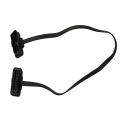
The OBD male (24V) to OBD female 90-degree bend flat wire with a length of 500mm is a specialized connectivity solution tailored for heavy-duty vehicle diagnostic systems, addressing the unique space and voltage requirements of 24V automotive environments. Unlike standard OBD cables, its design prioritizes both functionality and adaptability, making it an essential component for mechanics, fleet managers, and automotive technicians working with trucks, buses, or agricultural machinery that operate on 24V electrical systems.
At the core of this cable’s design is the 90-degree bend at the connector interface. This angled structure eliminates the problem of bulky straight connectors that often get in the way of other under-dash components or vehicle panels. In tight spaces—such as the cramped areas under the dashboard of large trucks—this bend allows the cable to fit snugly without straining the connector or the vehicle’s OBD port, reducing the risk of port damage from forced positioning. The flat wire construction further enhances its space-saving advantage: unlike round cables that take up more volume and can tangle easily, the flat design lies flush against surfaces, minimizing interference with other wires or mechanical parts.
With a length of 500mm, the cable strikes a balance between flexibility and stability. It is long enough to allow technicians to connect diagnostic tools (
such as code readers or scan tools) to the vehicle’s OBD port without restricting movement—whether the tool is placed on the driver’s seat, the floor, or a nearby workbench. Yet, it is not excessively long, which would lead to cable clutter or accidental tripping hazards in busy repair shops.
Voltage compatibility is another critical feature.
Optimized for 24V systems, the cable uses high-quality conductive materials that ensure stable current transmission without voltage drops, a common issue in low-quality cables that can skew diagnostic data. The male and
female OBD connectors are engineered to meet industry standards, featuring robust pins and a secure locking mechanism that prevents accidental disconnection during diagnostics. This reliability is vital, as interrupted connections can lead to incomplete scans or incorrect fault code readings, delaying repair processes.
Durability is also a key consideration. The flat wire is coated with a wear-resistant, flame-retardant material that withstands the harsh conditions of automotive environments—including exposure to oil, grease, and varying temperatures. This coating protects the internal conductors from damage, extending the cable’s lifespan even with frequent use in busy repair settings.
| Item |
Description |
| Product Name |
24V OBD 90° bend 500mm flat cable |
| Type |
24V Automotive OBD Flat Diagnostic Wiring Harness |
| Voltage |
24V DC, Customized Available |
| Pins Material |
Nickel-Plated Brass OBD Standard Terminals, Gold-Plating Optional |
| Plug Material |
PA66+GF Automotive Grade 90° Elbow OBDII 16Pin Male & Female Connector Housing, Black Flexible Flat PVC Cable Jacket |
| Working Temperature |
-40℃~+105℃ Or Customized |
| Length |
500±20mm / Customized Length Available |
| Minimum Insulation Resistance |
≥10MΩ |
| Maximum Conduction Resistance |
≤2Ω |
| Application Fields |
Heavy-duty truck & commercial vehicle 24V OBD diagnostic extension, narrow space vehicle OBD port wiring, fleet monitoring device connection, auto repair shop diagnostic tool extension, vehicle modification signal transmission, automotive electronic bench testing, custom flat OBD extension wiring harness |
| Specific Shipping Cost |
Please Contact Us |
In summary, this OBD cable combines space-efficient design, voltage optimization, and durability to meet the demands of 24V heavy-duty vehicle diagnostics. Its 90-degree bend, flat wire structure, and 500mm length make it a practical, reliable choice for professionals seeking to streamline diagnostic workflows while protecting both their tools and the vehicles they service.


