
grown brilliance tennis bracelet
9 month ago
Slim 1.9 ct Round Lab Diamond Tennis Bracelet for B2B Line Planning
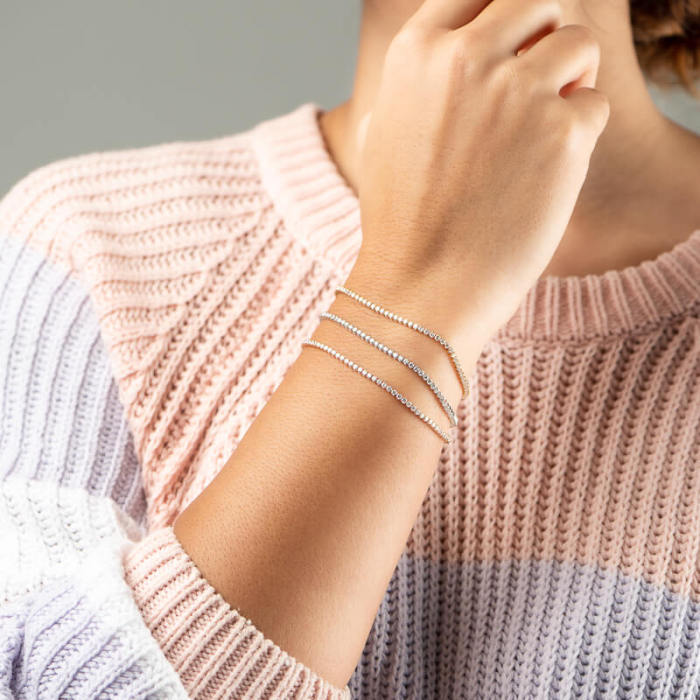
FLB-011 is a slim round lab diamond tennis bracelet shown as a 1.9 ct reference in the supplied visual material. The bracelet uses a continuous row of small round stones in individual raised basket links, with a fine white-metal appearance and a compact hook-style clasp connected to a round end ring. The strongest product value is not oversized stone presence; it is a narrow, controlled bracelet profile that helps B2B buyers build entry-level, stackable, and size-graded lab diamond bracelet programs.
The images show a lighter wearing proportion than higher-carat tennis bracelets in the same visual set. This makes FLB-011 useful for wholesalers, private-label brands, chain retailers, and designers who need clear clasp usability, small-stone consistency, and flexible customization space. Unconfirmed details must be confirmed before quotation or bulk production.
Differentiation Theme: Small-Carat Precision and Clasp Confidence
The selected direction combines product selling-point differentiation, buyer pain-point differentiation, and content-form differentiation. Product value comes from the 1.9 ct slim profile, round stone continuity, and compact clasp structure. Buyer pain points are small-stone consistency, clasp reliability, and scalable range planning.
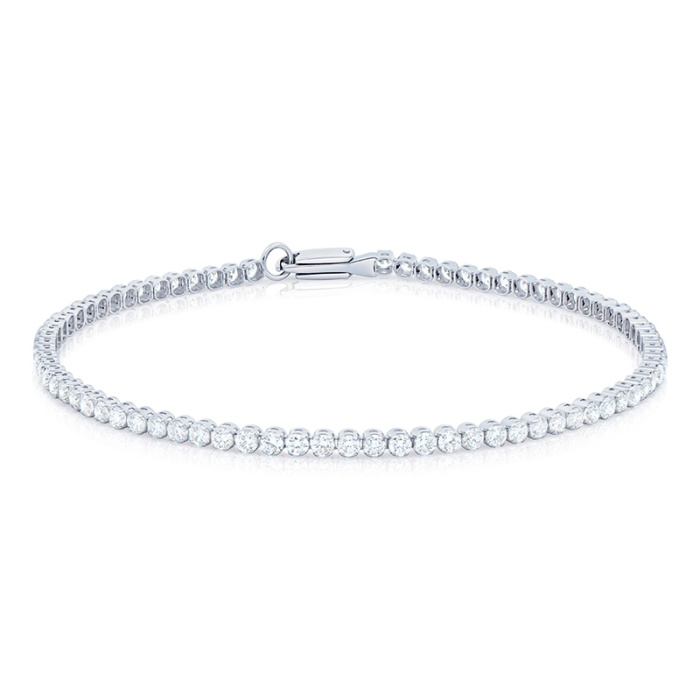
This separates FLB-011 from larger tennis bracelets and generic retail pages. A narrow 1.9 ct version can anchor the fine starting point of a lab diamond tennis bracelet range and help buyers compare 1.9 ct, 3.3 ct, 5.4 ct, and 6.9 ct versions.
Round Stone Line and Basket Link Construction
The bracelet shows small round stones arranged in a continuous tennis line. Each stone appears to sit in its own rounded basket link, creating a bead-like front profile and a visible gallery rhythm from the side. The 1.9 ct version is visually narrow and suited to buyers who want a fine wrist scale.
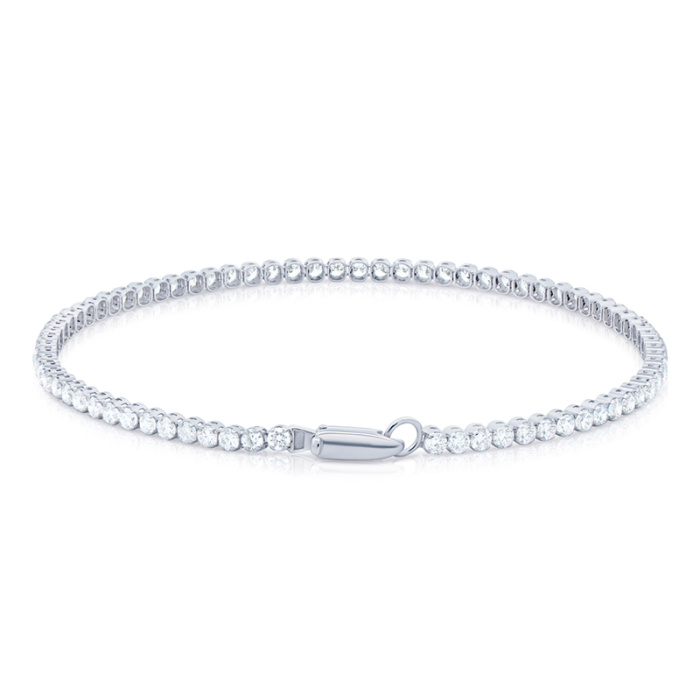
For manufacturing review, the challenge is consistency. Small stones expose uneven prong height, spacing, and link alignment quickly. A buyer should inspect whether each basket sits at a similar height, whether the stones face upward evenly, and whether the bracelet curves without kinking near the clasp.
Why small-stone consistency matters
A slim tennis bracelet depends on repetition. FLB-011 should be reviewed for line straightness, stone spacing, and the transition between the final stone links and the clasp end.
Hook-Style Clasp and Double-Safety Use Case
The close-up image highlights an easy one-handed clasp with a secure double-safety mechanism. Visually, the bracelet uses a hook-style clasp component connected to a round end ring, with a compact profile that matches the narrow bracelet line.
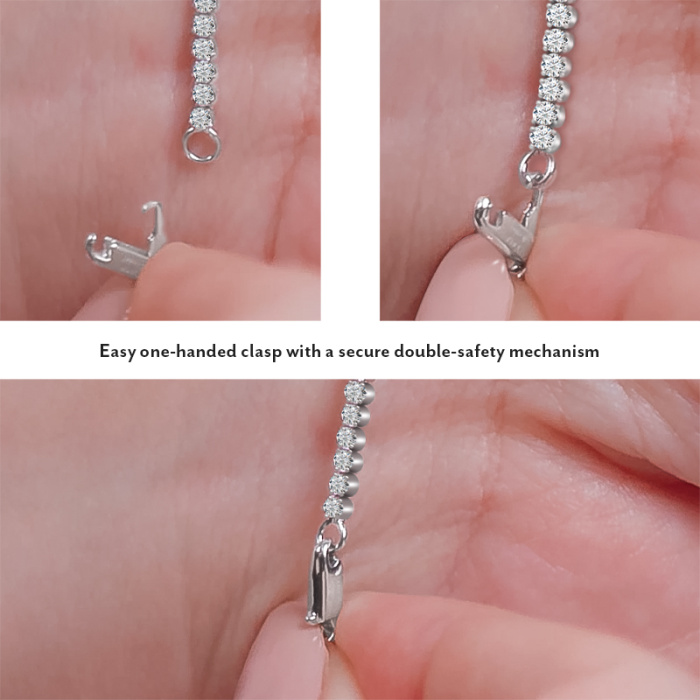
For B2B sourcing, clasp usability should be treated as a commercial feature. Buyers should check whether the clasp can be operated with one hand, whether the end ring is proportionate, and whether the safety structure can be repeated consistently in production.
Clasp review points
- Check the hook opening and closing movement from a close angle.
- Confirm that the end ring and clasp body match the slim bracelet scale.
- Review double-safety behavior before sample approval.
- Inspect polishing around the clasp body to avoid rough handling points.
1.9 ct Wearing Proportion and Assortment Planning
The wrist and comparison images show that the 1.9 ct version is the finest option in the visible carat range. It creates a delicate wrist line and leaves space for stacking with other bracelets. This makes it useful for lower-profile assortment planning.
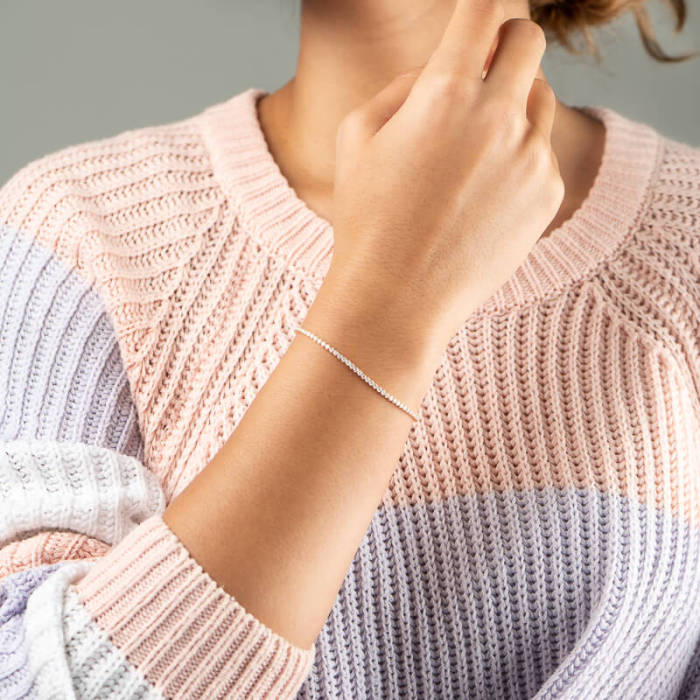
The 1.9 ct positioning should not be written as a low-price claim. A stronger B2B angle is range architecture. Buyers can use this model as the narrow starting point, then build upward with 3.3 ct, 5.4 ct, and 6.9 ct references where available.
| Visible Factor | B2B Meaning |
| 1.9 ct Scale | Narrow wrist coverage for fine-line bracelet programs. |
| Round Stone Repetition | Easy for buyers to compare quality consistency across samples. |
| Hook Clasp | Supports one-handed operation and compact bracelet finishing. |
| Carat Comparison Image | Helps position FLB-011 within a wider bracelet range. |
Customization Paths for Manufacturers and Brand Buyers
FLB-011 can be discussed as a custom manufacturing reference after the buyer confirms technical specifications. Potential customization may include stone weight planning, bracelet length, metal color, clasp finishing, laser engraving when required, and packaging direction, but each item must be confirmed through the order sheet.
The production discussion can follow CAD drawing, wax output, casting, model refining, stone setting, laser engraving when required, polishing, plating or color finishing when applicable, and final inspection. For this slim bracelet, extra attention should be placed on small-basket uniformity, clasp repeatability, and bracelet curve.
Development control points
Confirm the approved sample before bulk production, then compare production pieces against the same line width, clasp operation, stone spacing, and polishing standard. This keeps the narrow bracelet profile consistent across repeated orders.
Buyer Decision Guide for FLB-011
Buyers should select FLB-011 when the collection needs a slim round lab diamond tennis bracelet with a visible clasp usability story. It suits assortment plans that need a light wrist line, stackable proportion, and a lower-carat reference inside a broader tennis bracelet family.
Before confirming this model, compare it with heavier carat references using wrist photos rather than only table specifications. Consider target bracelet width, carat tiers, clasp preference, and layered use.
FAQ for B2B Buyers
Why position the 1.9 ct version as a separate page?
The 1.9 ct bracelet has a different buyer purpose from heavier tennis bracelets. It represents the slim entry point of the visible range, so the page should focus on fine wrist scale, stacking use, and small-stone consistency rather than broad luxury wording.
What should be checked first in a sample?
Check the round stone alignment, basket height, link curve, hook clasp operation, and double-safety behavior. These details decide whether the bracelet feels reliable enough for repeat buyer handling.
Can the bracelet support a carat range program?
Yes, the supplied comparison image shows 1.9 ct, 3.3 ct, 5.4 ct, and 6.9 ct references. Final availability, stone sizes, and technical specifications must be confirmed before using those options in an order.
Why emphasize clasp usability in this product?
A slim bracelet has limited visual mass, so the clasp must be secure without looking oversized. The close-up image gives buyers a practical reason to review one-handed operation and safety behavior before approval.
Specification Note
Visible materials confirm a slim round lab diamond tennis bracelet reference marked 1.9 ct, with repeated basket links, fine white-metal appearance, a hook-style clasp connected to a round end ring, one-handed clasp operation, and a double-safety mechanism shown in the close-up image. Exact metal purity, bracelet length, stone quantity, individual stone size, total finished weight, available metal colors, MOQ, lead time, certification requirements, and QC standard require confirmation before quotation, sampling, bulk production, or shipment.
Similar Video Recommendation


If you are interested in the product, contact Bossgoovideo.com for more information
- *To:
- Wuzhou Floral Jewelry Co., Ltd
- *Message:
-
Submit
Main Product:
lab grown diamond rings,
lab diamond jewelry,
lab diamond tennis bracelet,
lab diamond cuban link chain,
lab grown diamond ,
lab grown diamond engagement rings