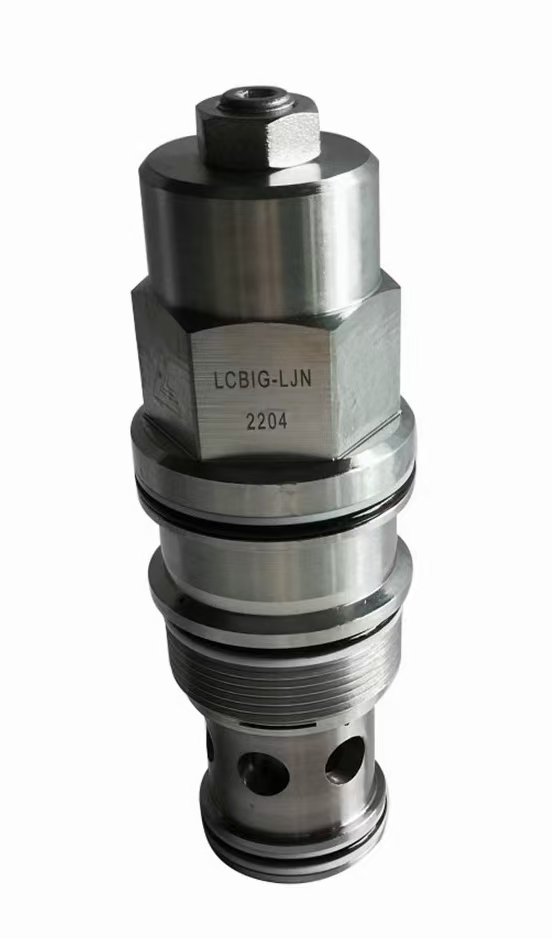
Working Principle
• Unidirectional Free Flow: Oil can flow freely fromPort ② (Inlet)toPort ① (Outlet)without additional control.
• Pressure Relief Control: When oil flows fromPort ①toPort ②, it operates via a direct-acting, pilot-assisted pressure relief function. The pressure atPort ③ (Pilot Control Port)reduces the effective setting of the relief valve by the pilot ratio, enabling precise load pressure control.
• Pilot Assistance: Pilot pressure introduced throughPort ③lowers the main relief valve's cracking pressure, allowing smooth valve response to load pressure variations.
------
III. Technical Specifications
• Maximum Setting Pressure: 350 bar
• Maximum Recommended Load Pressure: 270 bar (at maximum setting pressure)
• Flow Characteristics: Refer to pressure-flow curves (specific curves available in the product manual).
• Internal Leakage: ≤5 drops/minute
• Pilot Ratios:
• LCBIG: 4.5:1
• LCBIH: 10:1
• Temperature Range: -40°C to +120°C
• Filtration Requirements: Mineral oil viscosity range: 7.4 to 420 cSt; standard filtration required.
• Cartridge Type: SUN T-19A
• Manifold Material:
• 6061-T6 Aluminum Alloy: Rated for 207 bar
• Steel and Ductile Iron: Rated for 350 bar
------
IV. Applications
LCBIG/LCBIH counterbalance valves are widely used in hydraulic systems requiring overrunning load control, such as:
• Cranes: Preventing uncontrolled lowering of heavy loads due to gravity.
• Excavators: Controlling the descent speed of booms or buckets for smooth operation.
• Injection Molding Machines: Preventing rapid mold closure caused by gravity, protecting equipment and molds.
• Other Hydraulic Equipment: Including die-casting machines, lifting platforms, and other applications requiring load control.
------
V. Installation and Commissioning
1. Mounting Orientation: Ensure correct valve orientation to avoid reverse oil flow.
2. Pilot Control: Adjust pilot pressure according to system requirements for optimal control.
3. Pressure Setting: The counterbalance valve's setting pressure should be at least 1.3 times the maximum load pressure to ensure a safety margin.
4. Backpressure Considerations: Backpressure atPort ②increases the relief valve's setting by a factor of "1 + pilot ratio." Account for this during commissioning.
------
VI. Maintenance and Troubleshooting
• Regular Inspections: Check for leaks and ensurePort ③is not blocked.
• Seal Replacement: Replace seals if internal leakage increases due to aging.
• Filtration Maintenance: Ensure clean hydraulic oil to prevent contaminants from entering the valve and affecting performance.
• Common Faults:
• Excessive Load Descent Speed: May indicate insufficient pilot pressure or a low relief valve setting.
• Excessive System Pressure: Check for backpressure effects or a stuck relief valve.