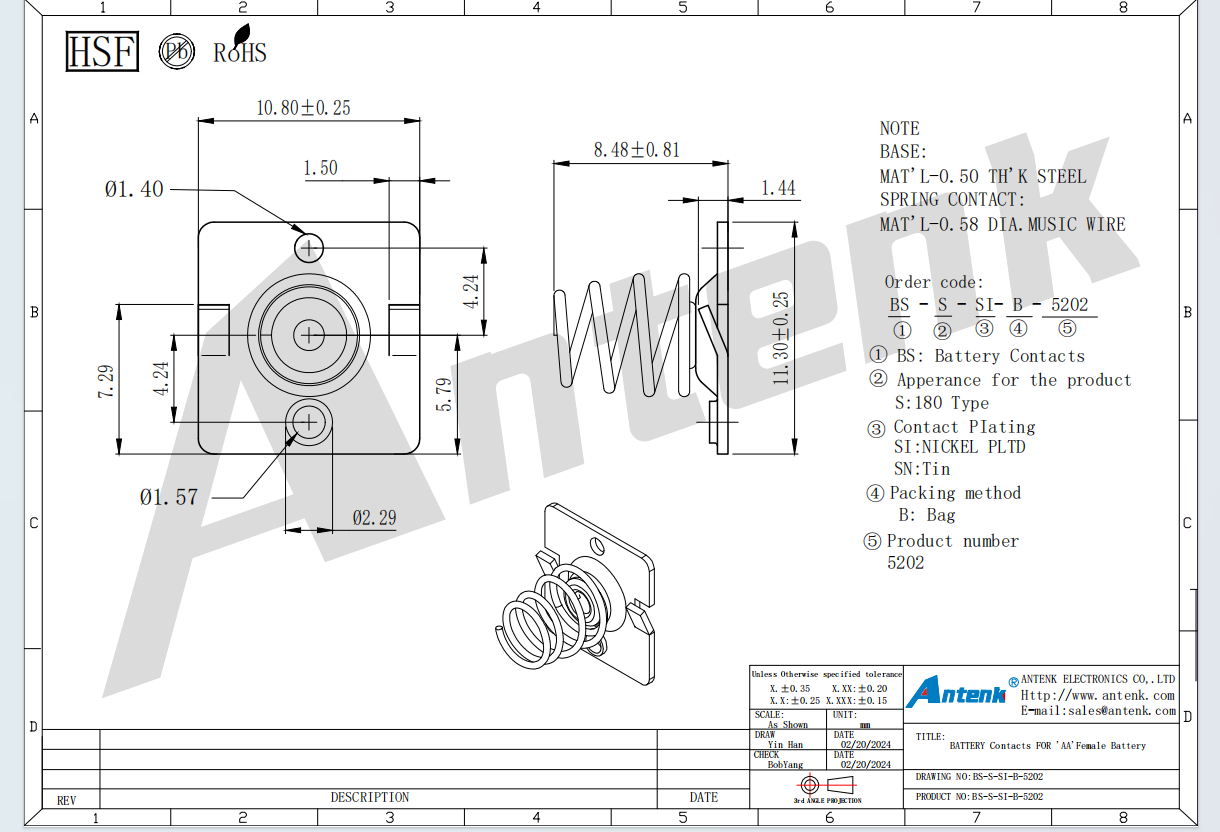
Battery contacts for ‘AA’ female battery applications are precision-engineered conductive components designed to interface with the negative terminal (the flat, recessed end) of a standard AA battery. In electronics, the term “female” refers to the contact that receives the battery’s terminal, rather than wrapping around it. For an AA battery, the female contact is typically a flat or slightly raised spring plate or a coil spring located at the negative end of the battery holder. Its primary function is to complete the circuit by providing a low-resistance, corrosion-resistant electrical path between the battery’s negative pole and the device’s PCB or wiring harness. Unlike the “male” contact at the positive end—which often uses a raised nipple or nub to touch the battery’s top button—the female contact must accommodate the battery’s flat base while ensuring consistent pressure. This pressure is critical: too little causes intermittent connection, while too much may damage the battery casing or the contact itself. High-quality AA female contacts are typically stamped from beryllium copper, phosphor bronze, or nickel-plated steel, balancing conductivity, spring temper, and manufacturability.
The design of AA female battery contacts varies depending on application requirements. The most common type is the coil spring contact – a helical spring made of tin-plated steel or stainless steel. It offers excellent shock and vibration resistance due to its progressive compression, making it ideal for portable devices like remote controls, flashlights, and medical monitors. Another popular variant is the dual-leaf or “F” type contact, which uses two parallel metal fingers stamped from a single sheet. This design provides redundant contact points, reducing the risk of open circuits if one finger becomes oxidized or contaminated. For high-reliability applications (e.g., industrial sensors or military equipment), gold-plated female contacts are used to prevent galvanic corrosion, especially when dissimilar metals are involved. Mechanical design must also account for insertion and removal cycles. A well-designed female contact for AA batteries should withstand at least 5,000 insertion cycles without significant loss of spring force. Engineers often specify a normal force of 50–150 grams per contact to ensure stable interface resistance (typically below 30 milliohms for new contacts). Additionally, the contact’s geometry must prevent reverse battery installation – many holders include a polarity keying feature in the female terminal’s plastic housing.
Material selection for AA female battery contacts directly impacts device longevity and performance. The most cost-effective option is nickel-plated cold-rolled steel (SPCC), used in disposable consumer electronics. For moderate durability, tin-plated phosphor bronze (C5191) balances corrosion resistance and conductivity. In demanding environments (extreme temperature or high humidity), beryllium copper (C17200) is preferred due to its excellent stress relaxation resistance – it maintains spring force even after prolonged compression. Manufacturing involves high-speed progressive stamping, followed by barrel plating for consistent finish. When selecting a female battery contact for a new product, key parameters include: (1) working current (AA batteries typically deliver up to 2A continuous), (2) operating temperature range (standard contacts: -20°C to +70°C; upgraded: -40°C to +120°C), (3) PCB mounting style (through-hole for wave soldering, SMT for automated assembly, or wire-lead for holders), and (4) compliance with RoHS and REACH regulations. Finally, engineers should always consider the battery’s expansion during discharge – alkaline AA batteries can swell slightly, so a well-designed female contact must retain electrical continuity even after moderate physical deformation of the battery cell.