Core Function and Structure
1. Two-way Three-port
• Two-way: The valve supports fluid flow in two opposite directions, making it suitable for systems requiring bidirectional control (e.g., pneumatic circuits, hydraulic systems).
• Three-port: The valve features three interfaces (inlet, outlet, exhaust/return port), enabling fluid path switching (e.g., charging, exhausting, pressure holding).
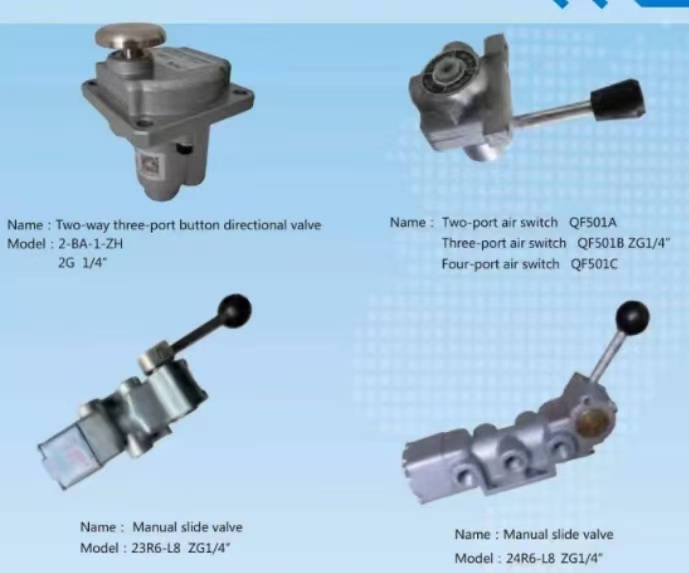
Two‑way three‑port button directional air valve is a manual push‑button operated pneumatic directional component, belonging to practical Pneumatic Parts. It is commonly connected with Power Pack Unit to realize air‑circuit switching for heavy‑duty industrial Machine. This mechanical button valve adopts spring‑return structure, which completes air supply, cut‑off and exhaust action by pressing and releasing the button. Without electric drive, it features high anti‑interference performance, widely used for original equipment assembly, pneumatic circuit modification and aftermarket spare‑parts replacement of engineering and mining equipment.
2. Button Directional Valve
• Operated via manual button pressing to shift the valve spool position, offering intuitive operation without external power (e.g., electromagnetic actuation).
• Ideal for scenarios requiring rapid manual intervention (e.g., emergency stops, mode switching).
Model Breakdown (2-BA-1-ZH)
1. 2: May indicate the valve series or category (e.g., second-generation product, specific application scenario).
2. BA: Likely represents button actuation (Button Actuation) or a manufacturer/
brand code.
3. 1: Could denote valve port size (e.g., DN1, 1/4-inch) or functional grade.
4. ZH: May signify additional features (e.g., explosion-proof design, special sealing materials) or mounting type (e.g., panel-mounted, pipe-connected).
Typical Applications
1. Pneumatic Control Systems: Used to control cylinder extension/retraction or pneumatic gripper clamping/releasing.
2. Hydraulic Equipment: Switches oil paths in small hydraulic systems (e.g., machine tool fixtures, lifting platforms).
3. Automation Devices: Serves as a manual control unit for semi-automated operations when integrated with PLCs or sensors.
4. Industrial Safety: Enables rapid fluid supply cutoff via button press during emergencies (e.g., gas leak response).
Technical Features and Advantages
1. Compact Design: Small footprint, suitable for space-constrained installations.
2. Simple Operation: Button-based design minimizes misoperation risks and requires no specialized training.
3. Instant Response: Manual actuation ensures zero delay, ideal for time-critical applications.
4. High Reliability: Mechanical structure eliminates electrical failure risks, reducing maintenance costs.
Selection and Usage Considerations
1. Port Compatibility: Verify valve port sizes (e.g., G1/4, NPT1/8) match the piping system.
2. Pressure Rating: Ensure the valve’s rated pressure meets system requirements (e.g., below 1.0 MPa).
3. Fluid Compatibility: Select appropriate sealing materials (e.g., NBR, FKM) based on the medium (air, water, hydraulic oil).
4. Environmental Adaptability: For outdoor or humid environments, choose models with higher protection ratings (e.g., IP65).