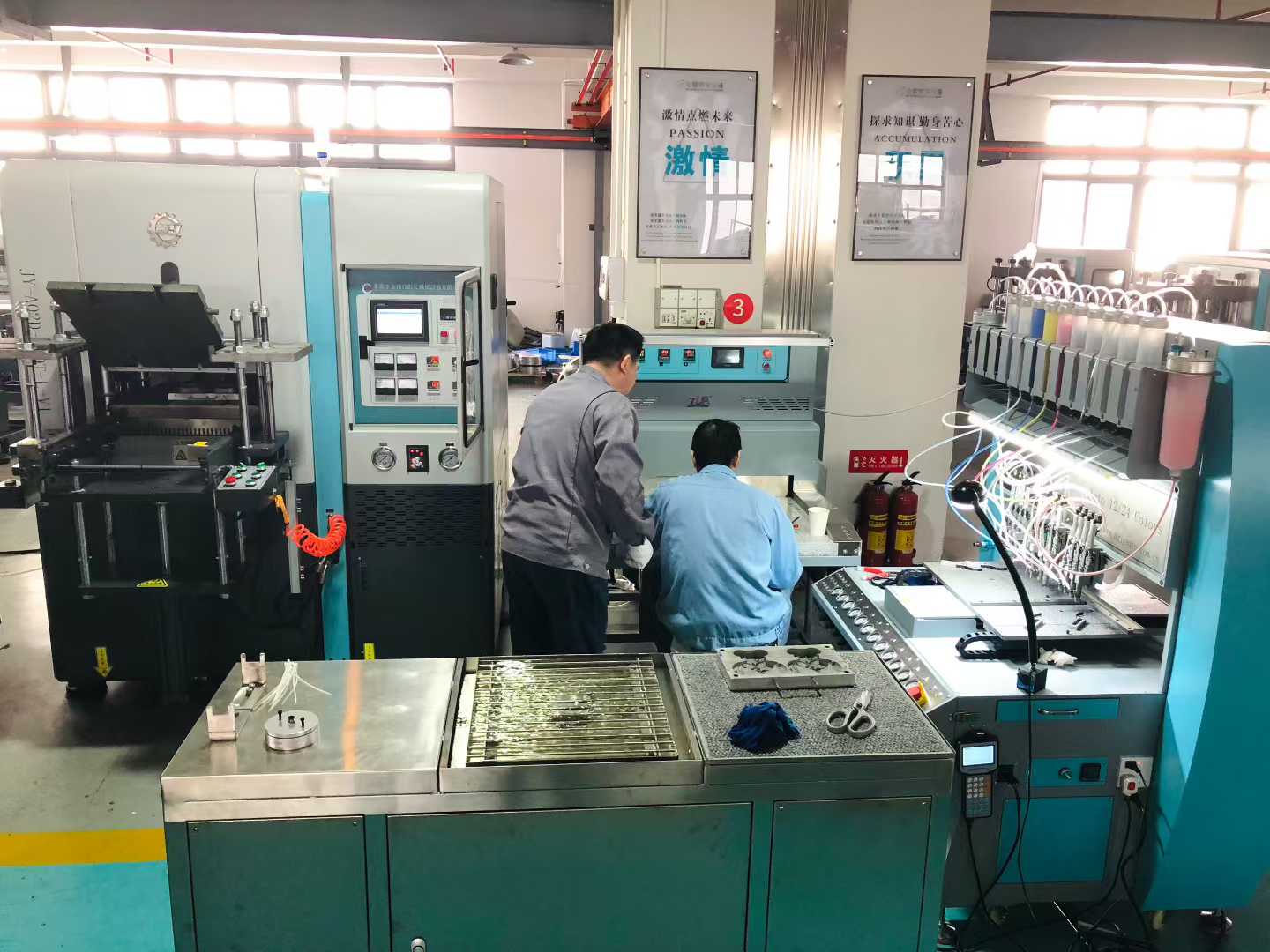
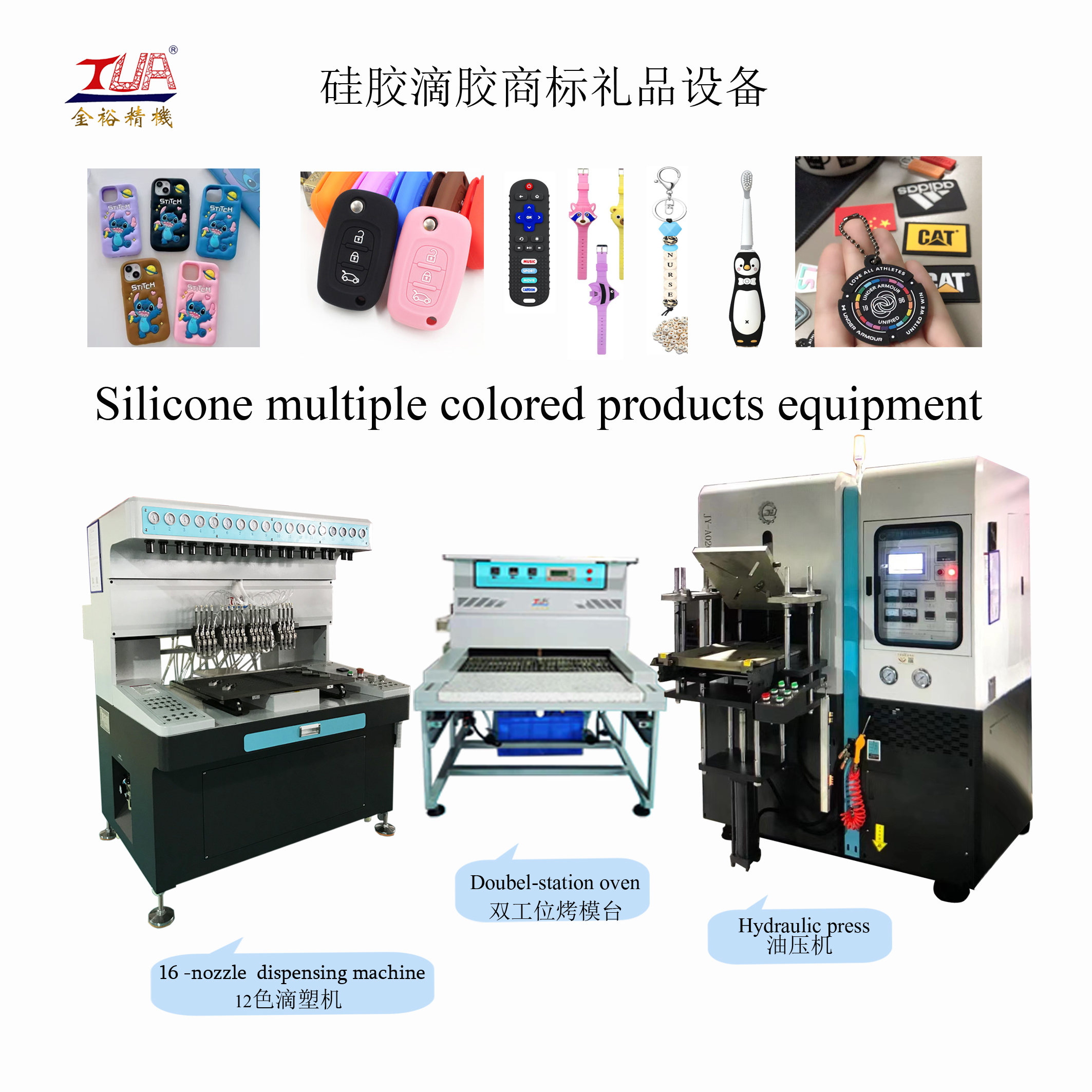
PVC baking ovens (or curing ovens) are critical equipment in the production of 3D PVC items such as garment labels, keychains, shoe accessories, and rubber patches. They are used immediately after a multi-color dispensing machine injects liquid PVC (plastisol) into the molds. Since liquid PVC plastisol requires heat to transform from a fluid paste into a durable yet flexible elastomer, these ovens provide the precise, controllable thermal environment necessary to complete the product's curing process.
Jinyu Machinery’s TUA-brand intelligent dual-station box/benchtop ovens are suitable for batch production or semi-automated lines. Molds are manually placed onto heating plates or racks within the enclosed chamber and remain there until the curing cycle is complete.
The prarameters of our double-station smart PVC & silicone oven:
| Name |
PVC/Silicone Oven |
PVC/Silicone Oven |
| Model |
JY-SO3-B-5050-V1 |
JY-SO3-B-4040-V1 |
| Voltage |
380V |
380V |
| Station |
2 |
2 |
| Wore area |
500*500mm |
400*400mm |
| Max temp |
400℃ |
400℃ |
| Cooling type |
Water cooling |
Water cooling |
| Total Power |
10.2kw |
10.2kw |
| Size |
1550*1300*1350mm |
1180*1200*1370mm |
| Weight |
400kg |
300kg |
The Curing Process (Gelation and Fusion)
Once the material-filled molds enter the oven, specific thermal reactions occur to cure the material:
Heating: Depending on the specific PVC formulation and product thickness, the operating temperature in the oven's heating zone typically ranges from 160°C to 300°C.
As the PVC paste heats up, the PVC resin particles begin to absorb the plasticizer. The liquid thickens, forming a fragile, semi-solid gel.
When the internal temperature of the material reaches the full curing point (usually above 170°C), the liquid PVC plastisol fully dissolves into the plasticizer, creating a continuous and highly durable solid matrix.
Jinyu Machinery’s ovens feature an integrated cooling system: after exiting the heating zone, the molds must be cooled rapidly. The machine automatically ejects the molds onto a cooling platform equipped with a water circulation system, allowing the finished PVC patches or labels to be safely demolded.
Maintaining stable, uniform temperature control across the heating plates is the most critical technical advantage of a high-quality oven. If the temperature fluctuates or drops too low, the PVC may become brittle or cure incompletely; conversely, if the temperature is too high, the material may scorch, blister, or discolor.
We also offer a model specifically designed for silicone. Just as in PVC production, the oven (or curing oven) is a critical piece of equipment in the silicone production line. However, the chemical reactions occurring inside the oven and the intended applications differ significantly from those of the PVC process.
While liquid PVC undergoes melting and fusion processes within the oven, silicone undergoes a chemical reaction known as vulcanization (cross-linking). Additionally, silicone ovens are widely used for post-curing (secondary curing) to ensure the final product meets rigorous safety and performance standards.
The Role of Ovens in Silicone Manufacturing
In industrial production lines manufacturing silicone patches, medical components, food-grade products, or automotive seals, ovens typically serve two primary functions:
1. Initial Curing (for Liquid Silicone Labels/Patches)
For production lines using multi-color dispensing machines to create 3D silicone labels or heat-transfer patches, the oven acts as the primary vulcanization chamber.
After the liquid silicone is injected into the mold, it is processed either by passing through a tunnel oven or by being placed in a batch (box-type) oven.
Heat (typically ranging from 100°C to 250°C, depending on the catalyst used) activates the curing agent (such as a platinum catalyst), prompting the liquid silicone to rapidly cross-link and transform into a solid elastomer.
2. Post-Curing (Secondary Curing)
For molded silicone components (specifically those produced via compression molding or LSR injection molding), the product is already in a solid state upon demolding. However, they must be placed in an industrial batch oven for post-curing.
This step is essential for medical-grade, food-grade (FDA/LFGB compliant), and high-performance industrial silicone components. It enhances the material's tensile strength, stabilizes dimensions, and eliminates odors or toxic residues.
Comparison: Silicone Ovens vs. PVC Ovens. Due to differing chemical process requirements, the design priorities for these two types of ovens often vary: Feature | Silicone Oven | PVC Oven | Air Circulation | Crucial. A robust exhaust and ventilation system is essential to remove volatilized gases (particularly during the post-curing stage). The process focuses on uniform surface heating to ensure the plastisol melts effectively. Temperature range: High sustained temperatures are typically required (reaching 200°C–250°C during post-curing), while gelation and melting generally occur between 150°C and 200°C. Heating method: Hot air circulation (convection) is commonly used to ensure uniform heating across all sides of the product; infrared (IR) heating panels or tubes are often employed above the molds.
Therefore, at Jinyu Machinery, our TUA brand has specifically developed dedicated production line equipment tailored to the distinct requirements of PVC and silicone materials; by using specialized machinery for specific applications, we further enhance product quality.