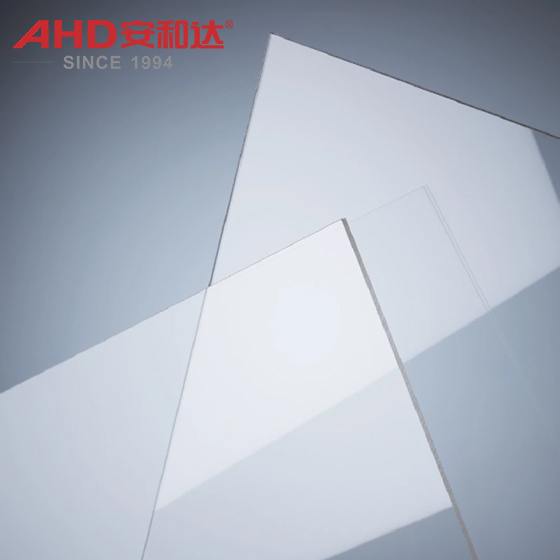
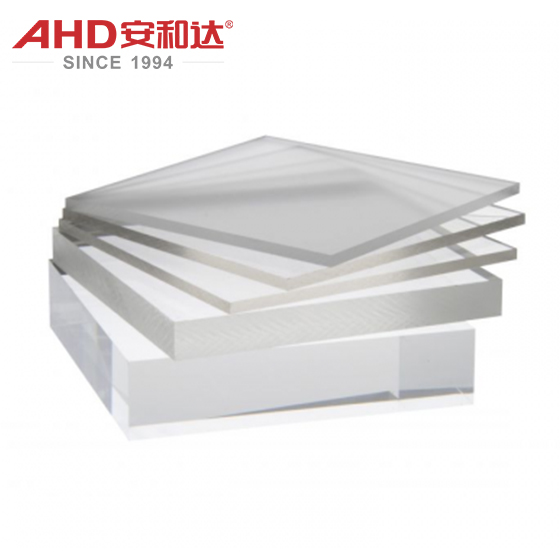
Color: transparent, translucent, colored (can be dyed or add masterbatch).
Product advantages
Extreme transparency and optical performance
The light transmittance is close to that of inorganic glass, and there is no dispersion (Abbe number 50-55), which is suitable for scenes with high requirements for light transmission and visual effects such as optical instruments, light boxes, and display cabinets.
High strength and impact resistance
The impact strength is 10-15 times that of glass, and it will be blunt-angled particles (non-sharp fragments) after breaking, which is highly safe and suitable for public facilities (such as subway platform shielding doors, school windows).
Lightweight and easy processing
The density is only 1/2 of glass, and the transportation and installation costs are low; it can be processed by cutting, drilling, hot bending, bonding, etc., and is suitable for customized shapes (such as special-shaped light boxes, sculptures).
Weather resistance and outdoor applicability
After adding ultraviolet absorbers, it is not easy to yellow or brittle in long-term outdoor use (lifespan can reach more than 10 years), which is better than ordinary PVC and PS materials.
Aesthetics and decoration
The surface has high gloss and can be dyed into a variety of colors, which is suitable for fields with high aesthetic requirements such as advertising and architectural decoration.
Environmental protection and recyclability
It can be 100% recycled, no harmful substances are released during the production process, and it complies with environmental protection standards such as RoHS and REACH. Some models have passed FDA food contact safety certification.
Precautions
Solvent resistance: Acrylic is easily swollen or dissolved by solvents such as ketones (acetone, butanone), esters (ethyl acetate), and chlorinated hydrocarbons (carbon tetrachloride). Avoid contact with such substances during processing or cleaning (neutral detergents are recommended).
Processing temperature: The heat deformation temperature is about 95°C. The temperature must be controlled at 120-150°C (local heating) during hot bending to avoid overheating and softening and deformation of the sheet.
Ultraviolet protection: UV absorbers (such as UV-531) must be added for outdoor use, otherwise long-term exposure will cause yellowing and brittleness of the surface (lifespan shortened to 2-3 years).
Fire resistance: The oxygen index of ordinary acrylic is about 17-18 (flammable), and flame retardants (such as bromine and phosphorus) must be added to meet the UL94 V-2/V-0 standard (oxygen index ≥ 26).