Deep Groove Ball Bearings: An Analysis of Advantages, Features, and Manufacturing Processes
Deep Groove Ball Bearings (DGBB) are versatile bearings with steel balls as rolling elements and continuous deep arc raceways on inner and outer rings. Widely used in motors, water pumps, automotive components and other fields, they feature practical advantages, distinct characteristics, and mature manufacturing processes.
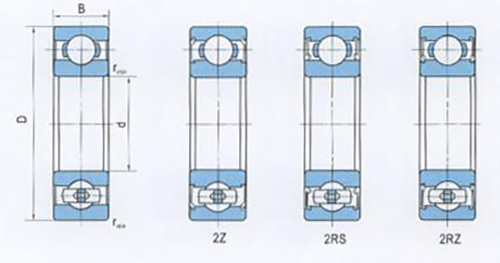
Their advantages are prominent and adaptable. First, they have a low friction coefficient. The point-contact design between steel balls and deep arc raceways reduces friction loss, and when paired with high-quality grease, they maintain efficient operation for long periods. Second, they exhibit excellent rotational performance. With a simple and compact structure, their limiting speed is higher than most roller bearings, and ordinary models can meet 10,000-rpm operation requirements. Third, they offer flexible load-bearing capacity, capable of withstanding both radial and bidirectional axial loads. Some models with seals also provide dust and water resistance, adapting to dusty, humid and other complex environments. Fourth, their costs are controllable. The simple structure and mature mass production make them far more cost-effective than precision angular contact bearings, satisfying general industrial needs.
Their structural features are concise and distinct. They mainly consist of inner rings, outer rings, steel balls and cages, with some models equipped with seals or dust covers. The raceways are deep arc-shaped, highly matching the curvature of steel balls to enable all-round load transmission. Cages are mostly made of stamped steel plates or engineering plastics—the former for ordinary working conditions, and the latter for high-speed scenarios due to lightweight and low friction properties. Classified by sealing type into open type, double rubber-sealed (2RS), double metal-sealed (2Z) and others, they meet different protection needs.
The manufacturing process is mature and rigorous. They are mainly made of GCr15 high-carbon chromium bearing steel, reaching a hardness of HRC 60-64 after quenching and tempering; 440C stainless steel is used for corrosion-resistant scenarios. Processing follows the sequence of "forging - turning - heat treatment - grinding - superfinishing". Raceway grinding precision reaches IT6 grade, with surface roughness as low as Ra 0.02μm. Assembly adopts the process of "automatic sorting - quantitative ball filling - cage riveting" to ensure uniform distribution of steel balls. Finished products undergo dimensional accuracy, rotational flexibility, and vibration noise testing. Ordinary models have vibration values controlled at Z1 grade to ensure operational stability.


