Casting Nylon Sheets, also known as MC Nylon (monomer casting nylon) or monomer casting nylon, are high-performance engineering plastics produced by direct casting polymerization of caprolactam monomers under normal pressure. The core production process involves mixing molten caprolactam monomers with alkaline catalysts (such as sodium hydroxide), activators, and other additives, then injecting the mixture into a preheated mold. This allows the material to rapidly polymerize within the mold, solidifying into a tough solid preform. Subsequent processing (such as cooling, cutting, and polishing) yields sheets of the predetermined dimensions.
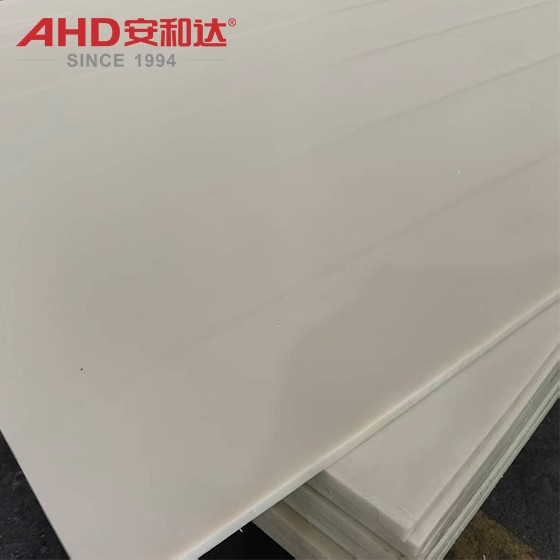
Biege Nylatron Sheet
Ⅰ. Core Characteristics
1. Superior Mechanical Properties
High Strength: Tensile strength (approx. 80-90 MPa) and compressive strength (approx. 110-130 MPa) are significantly higher than ordinary extruded nylons (such as PA6).
High Toughness: Notched impact strength reaches 50-80 kJ/m² (far exceeding PA6), maintaining good impact resistance even at low temperatures (not brittle at -40℃).
Fatigue Resistance: Not easily broken under repeated loads, suitable for long-term dynamic load scenarios (such as gears and bearings).
2. Excellent Wear Resistance and Self-Lubricating Properties
Low coefficient of friction (approx. 0.1-0.3), outstanding self-lubricating properties, can operate under dry friction conditions without additional lubrication, and the wear rate is much lower than metals or other plastics (such as POM).
Good embedding ability for dust and particles, suitable for wear-resistant parts in dusty environments.
3. Chemical Corrosion Resistance
Resistant to oils, solvents (such as hydrocarbons and alcohols), and weak acids and alkalis, except for strong acids (e.g., concentrated sulfuric acid) and strong oxidants. Superior to ordinary nylon (PA66 is easily corroded by strong alkalis).
4. Low Moisture Absorption
Water absorption rate is approximately 0.9-1.2% (23℃, 24h), lower than PA6 and PA66, exhibiting better dimensional stability and less performance fluctuation in humid environments.
5. Electrical Insulation
Volume resistivity is as high as 10¹⁴ Ω·cm, and dielectric strength is approximately 15-20 kV/mm, suitable for electrical insulation components.
6. Moderate Temperature Range
Long-term operating temperature range is -40℃ to 100℃ (short-term up to 120℃), superior to general-purpose plastics, but lower than high-temperature nylons (such as PA46).
AHD Casting MC Nylon Sheet
Ⅱ. Unique Advantages
Due to its higher molecular weight (70,000-100,000, compared to 20,000-30,000 for extruded nylon), MC nylon exhibits superior strength, toughness, and abrasion resistance compared to PA6/PA66, especially demonstrating greater stability under heavy loads and impacts.
Customizable and Functional: Fillers or modifiers can be added during polymerization to further enhance abrasion resistance, electrical conductivity, thermal conductivity, or reinforcing properties.
Large-Size Molding Capability: Casting processes allow for the manufacture of large sheets, reducing splicing requirements and lowering the processing costs of large parts.
Lightweight Metal Replacement: With a density of only 1.15 g/cm³ (approximately 1/7 that of steel), it provides near-metal load-bearing capacity, making it a suitable replacement for copper, aluminum, or stainless steel, reducing equipment weight and energy consumption (e.g., pump impellers, guide rails).
Maintenance-Free and Long Lifespan: Self-lubricating properties reduce lubrication requirements, while wear resistance and corrosion resistance extend component replacement cycles, making it particularly suitable for difficult-to-maintain environments (e.g., outdoor machinery, chemical equipment).
Ⅲ. Key Differences Between Extruded Nylon Sheets and Cast Nylon Sheets
Nylon sheets are classified into two categories based on their production process: extrusion and casting. The main differences between the two are as follows:
| |
Cast Nylon Sheet (MC Nylon) |
Extruded Nylon Sheet |
| Production Process |
Chemical Reaction Polymerization (Direct molding in a mold under normal pressure) |
Thermoplastic Processing (Extrusion molding after high-temperature melting) |
| Molecular Weight |
Extremely High (approx. 70,000-100,000, 3 times that of extruded nylon) |
Lower (approx. 20,000-30,000) |
| Mechanical Properties |
Superior strength, toughness, and impact resistance |
Balanced overall performance, but slightly lower strength and toughness |
| Abrasion Resistance |
Excellent (suitable for high-load, high-wear applications) |
Moderate (suitable for low-load applications) |
| Application Scenarios |
Heavy-duty, high-wear components |
General mechanical parts (e.g., appliance housings, ordinary gears) |
Ⅳ. Application Scenarios of Cast Nylon Sheets
The high wear resistance, high strength, and self-lubricating properties of cast nylon sheets make them suitable for heavy-duty, high-wear, and oil-free/low-oil extreme working conditions. Typical applications include:
Mining and Coal Industry: Coal mine chute liners, screen plates, scraper conveyor components.
Machinery Manufacturing: Large gears, bearing cages, drive shaft sleeves.
Automotive and Rail Transportation: Locomotive parts, automotive bushings, gaskets.
Chemical and Metallurgical Industries: Chemical equipment gaskets, steel rolling equipment guide devices.
Special Engineering Vehicles: Dump truck bed sliding plates.
Ⅴ. Precautions for Using Cast Nylon Sheets
To ensure the performance and service life of MC nylon sheets, the following points should be noted:
Temperature Control: The operating temperature should not exceed 100℃ (short-term tolerance to 120℃ is possible), otherwise it will cause the material to soften and its performance to deteriorate.
Installation Specifications: Avoid forced assembly (to prevent internal damage); ensure the contact surfaces are flat during installation to avoid localized stress concentration.
Regular Maintenance: Although it is a maintenance-free material, regular inspections are still necessary, and damaged parts should be replaced promptly.
Storage Conditions: Store in a dry, ventilated environment, avoiding direct sunlight; keep away from fire sources (caprolactam monomer is flammable).
Safety Protection: During production, wear a respirator (to avoid contact with caprolactam vapor) and gloves (to prevent burns); the workshop must be equipped with exhaust ventilation (to remove toxic gases).
Casting MC nylon sheets are a high-performance engineering plastic. Their excellent mechanical properties, abrasion resistance, and self-lubricating characteristics make them irreplaceable in heavy-duty, high-wear applications. Compared to extruded nylon sheets, MC nylon sheets have a higher molecular weight and superior performance, making them suitable for more extreme working conditions. Careful attention must be paid to temperature, installation, and maintenance during use to ensure safety and longevity.


