
Silicon Nitride AMB Substrate for Silicon Carbide Modules
2 year ago
Si₃N₄ AMB Copper-clad Substrate For SiC Modules
Puwei Ceramic's Si₃N₄ AMB Copper-clad Substrate represents the cutting-edge solution for next-generation silicon carbide power modules. Engineered specifically for the demanding requirements of high-power electronics, this advanced substrate combines the exceptional mechanical properties of silicon nitride ceramic with the superior thermal and electrical performance of Active Metal Brazing (AMB) technology.
Core Performance Advantages
- Optimal CTE Matching: Closely matches SiC semiconductor thermal expansion (3.2 vs 3.7 ppm/°C)
- Exceptional Thermal Shock Resistance: Withstands extreme temperature cycling in demanding applications
- Superior Mechanical Strength: 3-5x stronger than traditional alumina substrates
- Enhanced Current Carrying Capacity: Advanced AMB technology supports higher power density
- High Reliability Bonding: Stronger metallurgical bonds than conventional DBC methods
The silicon nitride ceramics selected for our Si₃N₄-AMB substrate feature a coefficient of thermal expansion that precisely matches SiC requirements, making them ideal for high-pressure, high-temperature, and high-frequency application environments. This compatibility makes our substrates perfectly suited for various SiC power module structures including HPD (High Power Density), DCM (Dual-Channel Memory), and T-PAK configurations in advanced Electronic Packaging.
Product Visual Documentation
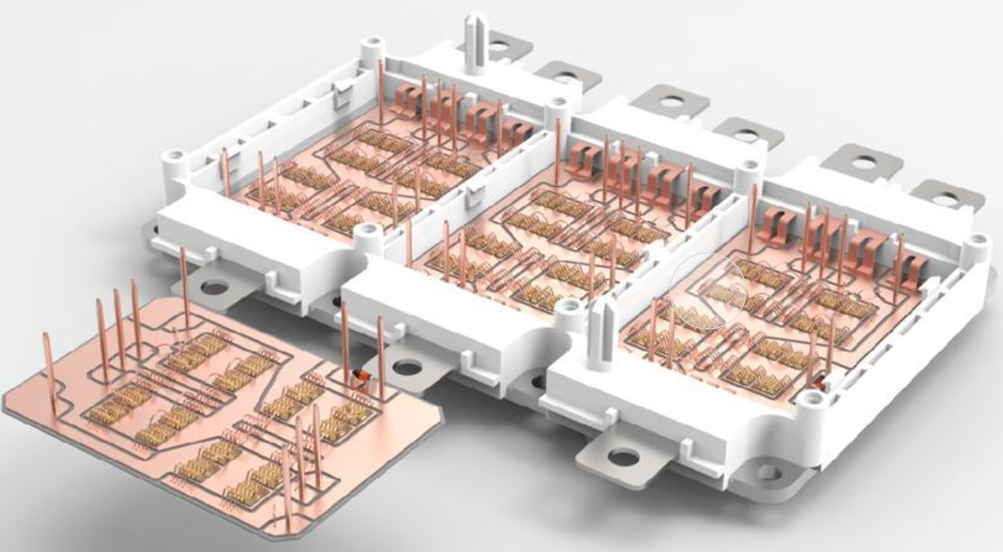
High-performance Si₃N₄ AMB substrate optimized for SiC power applications
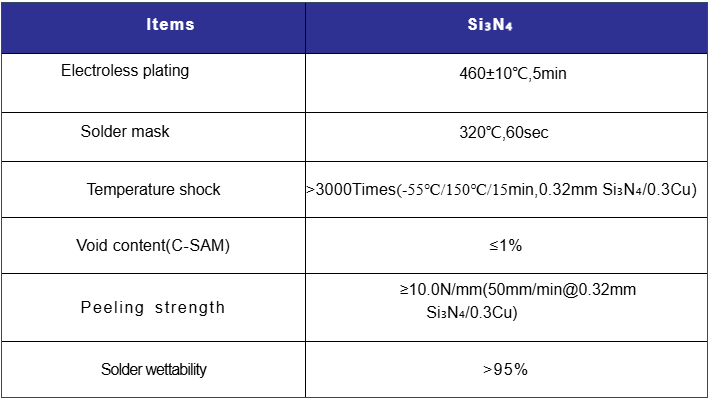
Comprehensive technical performance comparison showing silicon nitride advantages
Technical Specifications
Material Properties
- Base Material: High-purity Silicon Nitride (Si₃N₄) Ceramic
- Cladding Material: Oxygen-free high conductivity copper
- Thermal Conductivity: 80-90 W/m·K optimal for SiC applications
- Thermal Expansion Coefficient: 3.2 ppm/°C (matches SiC chips)
- Flexural Strength: >800 MPa for exceptional mechanical durability
- Dielectric Strength: >15 kV/mm for reliable electrical isolation
- Peel Strength: >80 N/cm for robust copper-ceramic bonding
Performance Advantages vs Traditional Substrates
- Thermal Shock Resistance: Significantly superior to aluminum oxide DBC substrates
- Toughness Strength: Enhanced fracture resistance compared to alumina ceramics
- Current Carrying Capacity: Improved performance over traditional DBC substrates
- Bonding Strength: Advanced AMB technology provides superior adhesion
- Thermal Cycling Performance: Excellent stability under repeated temperature changes
Product Features & Advantages
Optimal CTE Matching with SiC Semiconductors
The thermal expansion coefficient of our silicon nitride ceramics (3.2 ppm/°C) closely matches that of SiC semiconductors (3.7 ppm/°C), minimizing thermal stress at critical interfaces. This compatibility extends product lifetime and enhances reliability in high-power Integrated Circuits and advanced Microelectronics Packaging applications.
Superior Thermal Shock Resistance
Our Si₃N₄-AMB substrate clearly outperforms traditional aluminum oxide DBC substrates in thermal shock resistance and toughness strength. The unique microstructure of silicon nitride prevents crack propagation under rapid temperature changes, making it ideal for harsh thermal environments in Power Devices and automotive applications.
Advanced AMB Manufacturing Technology
The AMB substrate manufacturing process represents a significant improvement over traditional DBC methods. Compared to conventional DBC substrates, our AMB substrates offer substantial advantages in current carrying capacity, bonding strength, and long-term reliability for demanding High-Power Microelectronic Components.
Exceptional Mechanical Durability
With flexural strength exceeding 800 MPa, our silicon nitride substrates provide 3-5x greater mechanical robustness compared to alumina substrates. This superior strength withstands mechanical stress, vibration, and thermal cycling in the most demanding applications, ensuring reliable performance in challenging operating conditions.
The "SiC + AMB" Technology Advantage
As electric vehicles become the largest terminal market for AMB ceramic substrates, the industry is rapidly adopting the "SiC + AMB" technological route. To address range anxiety in new energy vehicles, the penetration rate of 800V high-voltage architecture is increasing, making our Si₃N₄-AMB substrate the preferred packaging solution for automotive electric drive, rail transit inversion, wind-solar-storage, and hydrogen energy applications.
Implementation and Integration Guidelines
- Application Requirements Analysis – Evaluate your specific power module requirements, including thermal management needs, mechanical stress factors, and electrical performance specifications for optimal Electronic Packaging design.
- Thermal and Mechanical Simulation – Utilize material property data for comprehensive performance modeling, ensuring the substrate meets your thermal management and mechanical reliability requirements.
- Substrate Design and Customization – Provide your circuit layout and specifications, leveraging our expertise in metallized ceramics to create optimized substrate designs for your SiC modules.
- Prototype Fabrication and Testing – Manufacture validation samples for rigorous thermal cycling, power cycling, and mechanical stress testing under simulated operating conditions.
- Assembly Process Optimization – Adapt your assembly processes to leverage the unique characteristics of silicon nitride AMB substrates, ensuring proper thermal management and mechanical integrity.
- Comprehensive Quality Validation – Perform thorough electrical, thermal, and mechanical testing to validate performance meets industry standards and application-specific requirements.
- Volume Production Scaling – Transition to mass production with our robust quality assurance systems and manufacturing expertise, ensuring consistent, reliable performance across all units.
Application Scenarios
Electric Vehicle Power Systems
As the largest terminal market for AMB ceramic substrates, electric vehicles benefit from our Si₃N₄ substrates in traction inverters, onboard chargers, and DC-DC converters. The 800V high-voltage architecture in new energy vehicles particularly benefits from the "SiC + AMB" technological route for enhanced performance and reliability. These are essential for automotive electronic ceramic substrates).
Rail Transportation Systems
Power conversion and control systems in high-speed trains and rail infrastructure where reliability under vibration, mechanical stress, and temperature extremes is paramount for safety and operational efficiency.
Renewable Energy Infrastructure
Wind-solar-storage integration systems and hydrogen energy applications requiring robust thermal management, excellent thermal shock resistance, and long-term reliability in outdoor environments with wide temperature variations. Ideal for power semiconductor ceramic substrates).
Industrial Power Electronics
High-power motor drives, industrial automation equipment, and power conversion systems demanding exceptional mechanical strength, thermal cycling performance, and reliability in harsh industrial environments. Used extensively in IGBT ceramic substrates).
Advanced Power Semiconductors
Next-generation SiC power modules including HPD, DCM, and T-PAK configurations where thermal management, CTE matching, and mechanical robustness are critical for performance and longevity in High-Frequency Modules and Microwave Applications.
Optoelectronics & High-Power Lasers
Used in laser diode ceramic heat sinks) and high-power LED modules where superior thermal dissipation extends device lifetime and ensures consistent optical performance.
Similar Video Recommendation


If you are interested in the product, contact Bossgoovideo.com for more information
- *To:
- Shaanxi Puwei Electronic Technology Co., Ltd
- *Message:
-
Submit
Main Product:
Alumina Ceramic Substrates,
Aluminum Nitride Substrates,
Metallized Ceramics,
AlN Ceramics Disc,
DPC Substrate ,
DBC Ceramic Substrate