Feature
1.Intelligent and efficient
Product model AS-E022, featuring a wide voltage input design (85~265V), can adapt to complex grid fluctuations and possesses excellent compatibility and stability. Its power factor (PF value) is above 0.95, making it a High Power Factor (PF) Emergency Light. It effectively reduces reactive power loss and improves the efficiency of grid power utilization, meeting high standards of energy conservation and environmental protection.
2. Long-lasting and reliable
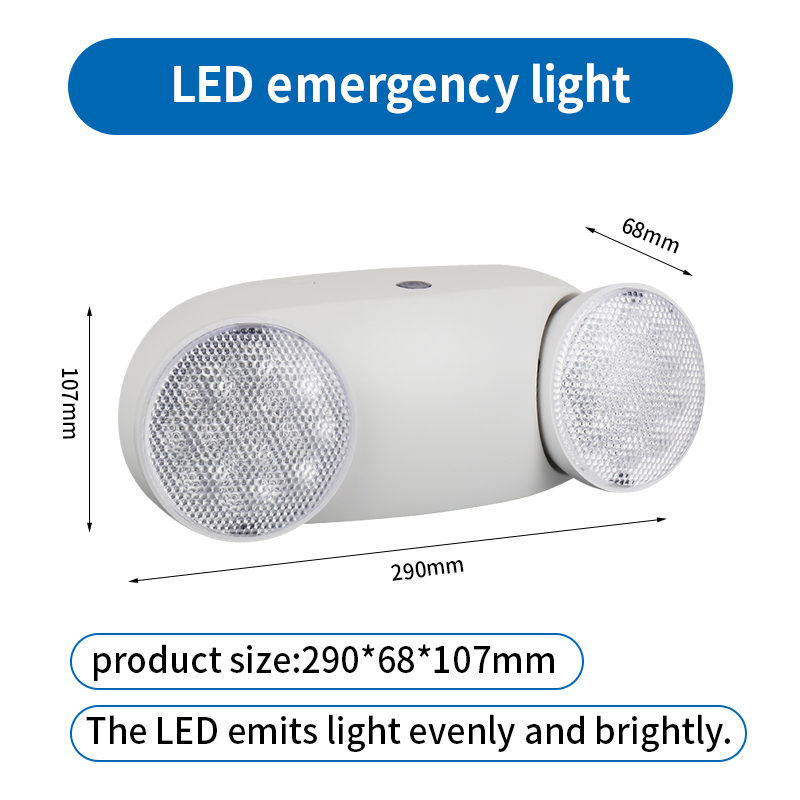
It is equipped with a 3.7V, 2200mAh large-capacity lithium-ion battery, ensuring that it can provide emergency lighting for up to 180 minutes after the main power supply is interrupted. The emergency lighting power is 2*3W, and the dual-light source design provides more uniform and reliable lighting coverage. The product body is made of flame-retardant ABS material, with dimensions of 29*6.8*10.7mm, featuring a compact and durable structure.
3. Safety certification
This product strictly complies with international safety and environmental protection standards and has obtained CE and RoHs certifications. The CE mark indicates that it complies with the EU safety directive, and the RoHs certification ensures that the product materials do not contain restricted harmful substances. With a 3-year warranty period, it provides users with a reliable commitment and guarantee from product safety to long-term use.
1.In evacuation corridors and safety exits of large public buildings such as shopping malls, hotels, and office buildings, this lamp can provide guiding illumination for up to 3 hours. Its high power factor characteristic reduces line losses and is suitable for centralized power supply scenarios with large areas and multiple installations, helping to achieve overall energy conservation for the building.
2. It is applicable to important equipment rooms such as power distribution rooms, pump rooms, and machine rooms. As a High-power Emergency Light, its dual-light source design can provide sufficient brightness, enabling personnel to conduct necessary equipment inspections or emergency operations after a power outage, preventing secondary accidents.
3. In life-related areas such as hospital operating rooms and corridor of patient rooms, reliable emergency lighting is crucial. The lamp can be equipped with high-performance Lithium Iron Phosphate Battery Pack or Ternary Lithium-ion Battery Pack. The former has a long cycle life and high temperature resistance, while the latter has high energy density, meeting different environmental and cost configuration requirements.
4. For environments such as underground garages, warehouses, and factory workshops, this product has good environmental adaptability. Selecting models with corresponding protection grades can make it a reliable Waterproof Emergency Light, capable of coping with damp and dusty challenges, ensuring continuous and stable protection.
Maintaining
1.Regular functional test: A simulated power outage test should be conducted monthly to verify whether the lamps can automatically switch to emergency mode and remain illuminated continuously. Record the test date and lighting duration, and confirm that it meets the rated standard of 180 minutes. After the test, ensure that the lamps return to the main power charging state.
2. Appearance and cleaning: Regularly inspect the integrity of the lamp housing and lampshade, checking for any cracks or obvious dust accumulation. Use a dry soft cloth to clean the surface of the lampshade to maintain the best light transmission rate. Check if the installation components are secure to avoid loosening or detachment due to vibration.
3. Battery status monitoring: Pay attention to the attenuation of the emergency lighting time. When the regular test reveals that the lighting time is significantly lower than 80% of the rated value, it may indicate a decrease in battery capacity. Contact a professional for inspection and consider replacing the matching lithium iron phosphate battery pack or lithium cobalt oxide battery pack.
Installation
1.Location planning and selection: Based on the lighting requirements and evacuation plan at the site, determine the installation locations for the lamps. These are typically on the walls of passageways, at stairway corners, or above equipment. The installation height must comply with local fire regulations, usually at a height of 2.2 meters to 2.5 meters from the ground, ensuring that the light coverage is without any blind spots.
2. Standardize electrical wiring: Installation must be carried out by professional electricians under power-off conditions. According to the product labels, accurately connect the main power input lines (L/N), and ensure a reliable connection of the grounding wire. Verify that the input voltage is within the rated range, all connection terminals should be tightened, and proper insulation protection should be provided.
3. Fixation and functional verification: Use appropriate accessories to securely install the lamp base on the wall or ceiling. After powering on, observe the status of the power indicator light. Conduct a complete power-off emergency function test to confirm that the automatic switching is rapid, the brightness of the dual light sources is uniform, and the duration meets the standards. Complete the final inspection.


