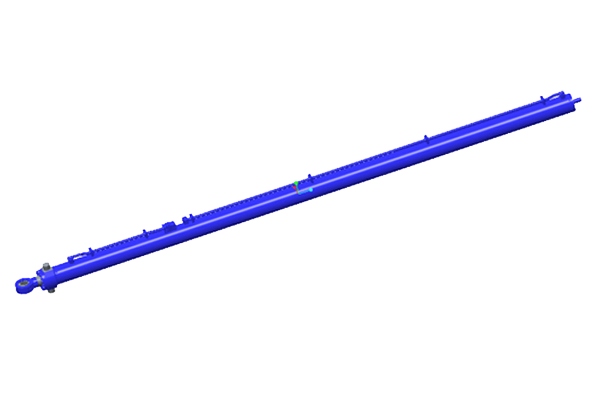
"Pressure Cylinder" and "Rotary Drilling Cylinder":
Pressure Cylinder
The Pressure Cylinder is an actuator in a hydraulic system that generates force or motion through liquid pressure. In a Pressure Cylinder, hydraulic oil is pumped into one end of the cylinder, pushing the piston towards the other end. This movement can produce linear force or motion, used in various machinery and equipment.
Pressure Cylinders typically have the following characteristics:
• Strong bearing capacity: Capable of withstanding high pressure and loads.
• Smooth motion: Designed with guiding mechanisms to ensure smooth piston movement within the cylinder.
• Excellent sealing performance: High-quality sealing devices are used to prevent hydraulic oil leakage.
Pressure Cylinders are widely used in situations requiring stable pressure and force, such as construction machinery, metallurgical equipment, shipbuilding, and other fields.
Rotary Drilling Cylinder
The Rotary Drilling Cylinder is a hydraulic cylinder specifically designed for rotary drilling rigs, providing the power required for drill pipe rotation and drilling. It typically works in conjunction with the power system, transmission system, and control system of the rotary drilling rig to achieve automated and efficient drilling.
Rotary Drilling Cylinders have the following characteristics:
• High-pressure stability: Capable of withstanding high pressure and vibration during drilling, ensuring drilling stability.
• Flexible rotation: Controlled by the hydraulic system to achieve flexible rotation and drilling of the drill pipe.
• Strong adaptability: Adjustable and optimizable according to different drilling needs and geological conditions.
Rotary Drilling Cylinders play a crucial role in infrastructure construction, mining, geological exploration, and other fields. They have become indispensable construction equipment, especially in projects such as high-speed railways, highways, large bridges, and deep foundation engineering.